
This article describes how to pull off an EV roadtrip while towing a trailer, with the dramatic impact to range caused by the additional drag. Further, it details how to do this with only campground charging, since public charging is troublesome when towing a trailer.
DC Fast Charging has been getting deployed nationwide since the mid 2010’s, and by now EV roadtrips are commonplace. Highway routes are well covered by DCFC, and EVs can now absorb 150 kW or more, reducing charging stops to 30 minutes or less. But if you’re towing a trailer, it gets quite a bit more challenging, and this page will walk you through the issues and solutions, based on the experiences of multiple EV owners and multiple trailering trips.
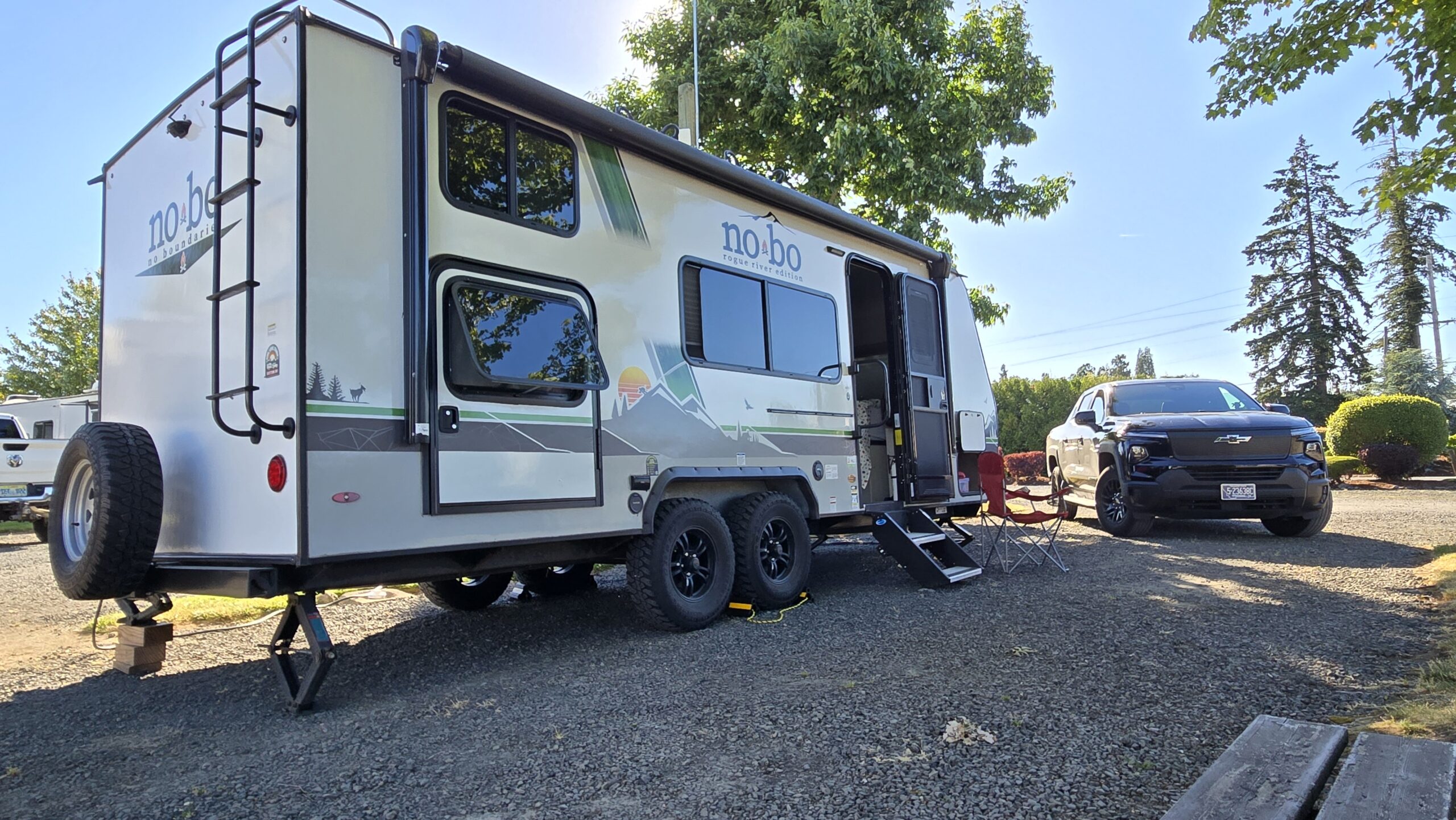
In summary, detailed further below (click to jump ahead):
Towing a trailer requires learning some new skills and pretty serious defensive driving when on the move. This page will not go into trailering basics, which you can learn elsewhere. But be aware that there are a lot of things to learn, including tow vehicle limits, trailer and tongue weight, electrical wiring, safety checks, bridge weight limits and height limits (e.g. gas station canopies), and simply how to back up.
If you’re new to towing, consider renting a small flatbed locally for a couple hours just to try it out (e.g. go get some landscape supplies). If your own EV can’t tow, rent a regular pickup truck to do that test. In both cases it’s surprisingly cheap to rent them for just a few hours. Then move up to a small trailer and try out a camping weekend. If you’ve never been to a campground in an RV, there’s a lot to learn there too (for starters, sewage dumping). The first time you do it, be prepared to be spending more learning (and making mistakes), and perhaps less time getting to actually relax and enjoy the trip. But you will learn and it will get better!
Aside from range concerns (detailed below), electric vehicles are fantastic for towing due to their powerful, torque-y drivetrains and buttery-smooth accel / decel behavior. If your own EV has towing capability, then you can of course choose to tow with your own vehicle, however the typical household EV will have limited weight ratings for what you can have under tow.
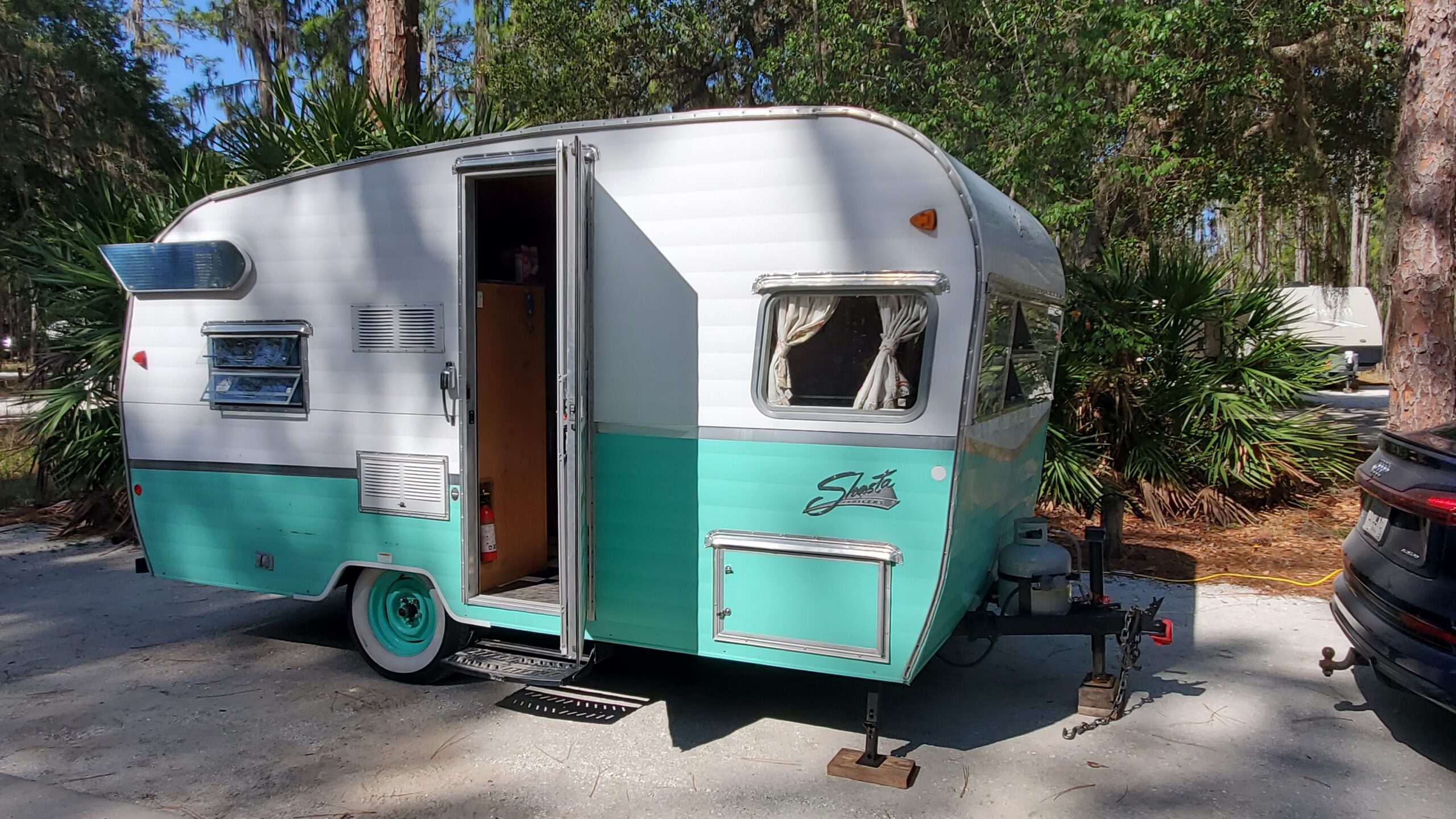
Towing a trailer has a dramatic effect on aerodynamics — when towing a trailer, your range typically gets cut in half, or even a little worse. This is true for both fossil fuel vehicles and electric vehicles, but is more noticeable in EVs because of their more limited energy capacity (battery vs fuel tank) and more limited fueling locations. It’s therefore useful to go into this knowing some things about both your towing vehicle and the efficiency you can expect, and thus the resulting range.
Start off with finding out what the usable energy capacity of your EV’s battery is. Energy is measured in kWh (not kW), and you can think of battery capacity as how much electrical energy can it hold — like gallons of fuel in a tank, except it’s gallons of electricity. Manufacturers will often state either the “total” battery size, or the smaller “usable” size. The usable size is slightly smaller because that’s a key way they can make these EV batteries last for a decade or more — they don’t use the full 0-100% energy charge-discharge range of the battery, rather they use say 5-95%, and don’t use the extreme ends of the battery’s range. So, for example, a Rivian R1T might have a 135 kWh battery, but only 125 kWh is usable. You’ll need that usable number here in a minute, so it’s important to find out what it is, and note that you might have to do some googling to figure it out, if the manufacturer is only stating the gross / total size, to find out what owners / media are reporting it as.
Next, you’ll need to know what kind of efficiency you are getting.


Less than 100 miles of range?! Sounds pretty bad, right? Indeed it is, and that’s why, if you are towing a big RV trailer, you should consider renting one of the big-battery trucks as discussed in the section above. But you can also make it work with a smaller battery EV, as long as you stay aware of your energy situation, have a robust charging plan, and keep your speed down! There’s an old EV rule: “slow down to go far”. It started in the old days when batteries were much smaller than they are now, but with the advent of trailer towing even being possible in an EV, that old rule is now back.
You can use the guidelines above to estimate your expected efficiency, but the best method is to do some actual tests during the beginning of your drive. While cruising on the highway with the trailer attached, hunt around in your EV’s screens for efficiency displays, which might be part of the trip odometer / trip computer feature. Worst case, watch your battery SOC percentage, and use the drop in SOC during a drive (and some math) to figure out a crude efficiency number. You can also watch the range-remaining number on your dash, which will update over time to match actual conditions such as towing and speed. Typically it takes about 15 minutes of driving (in new conditions such as trailer hitched up or new cruise speed) to update that range display, but even then it can be quite inaccurate, including being too optimistic. There’s a reason EV owners call the range gauge a “GOM” or “guess-o-meter”.
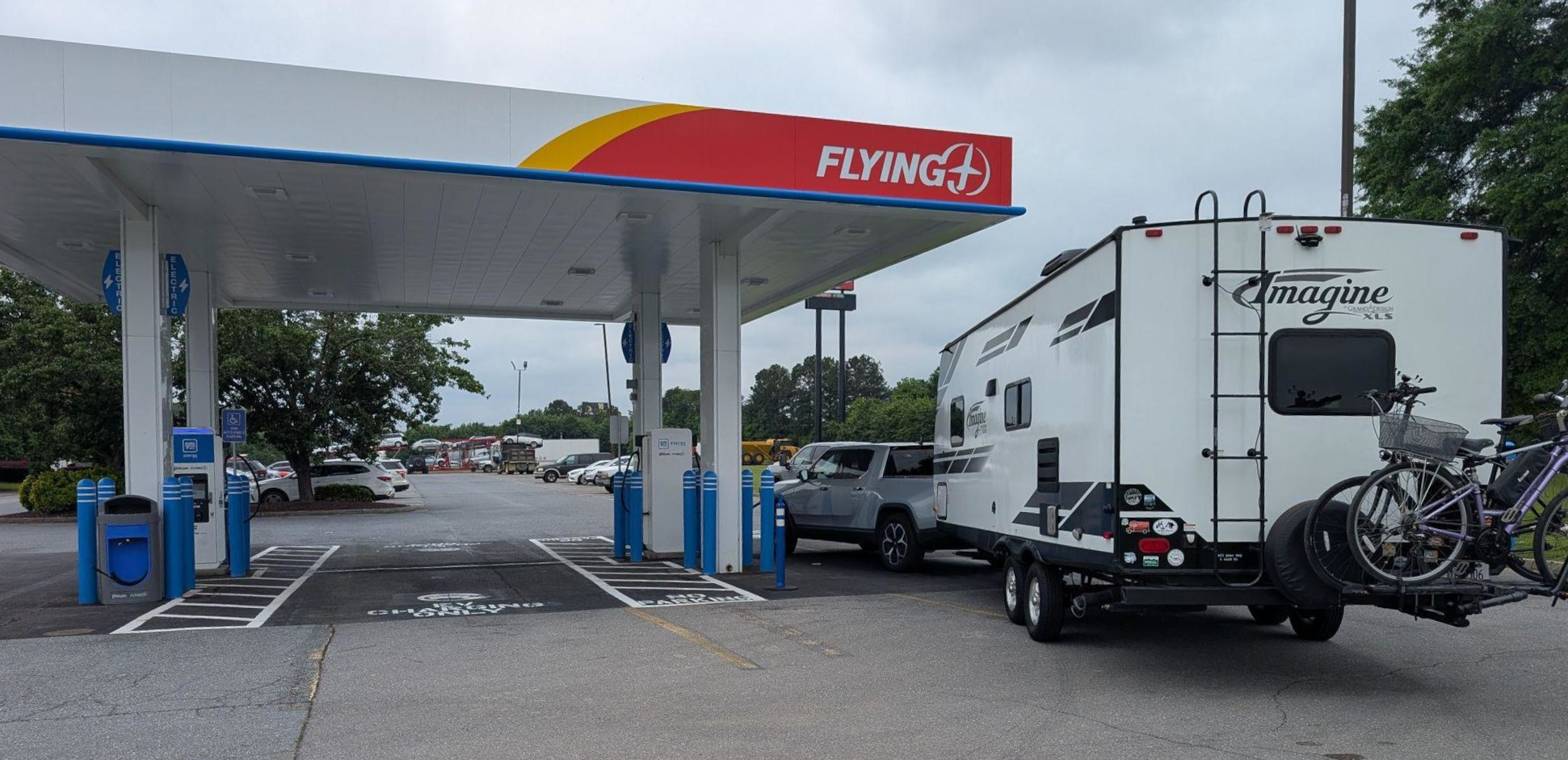
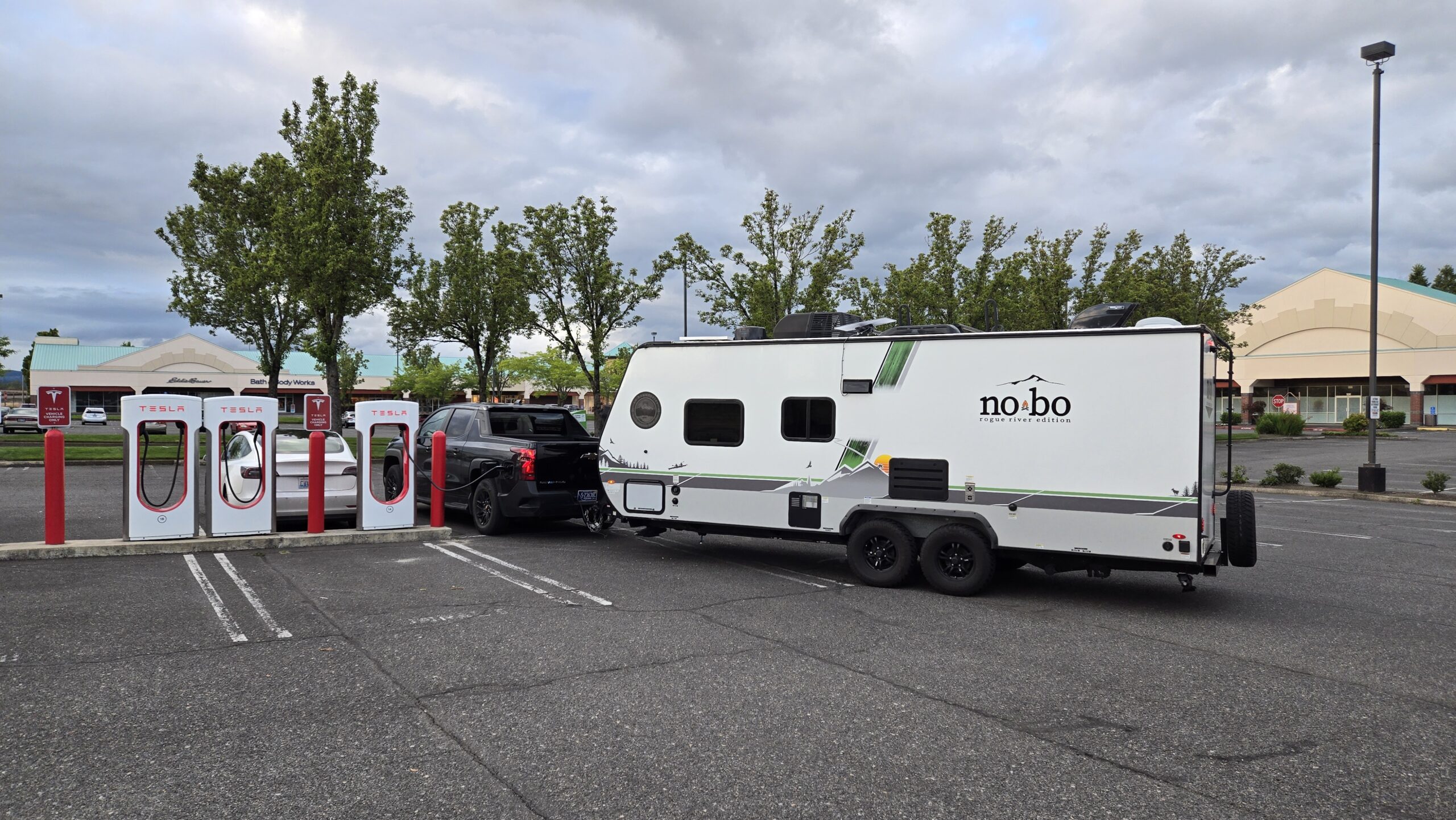
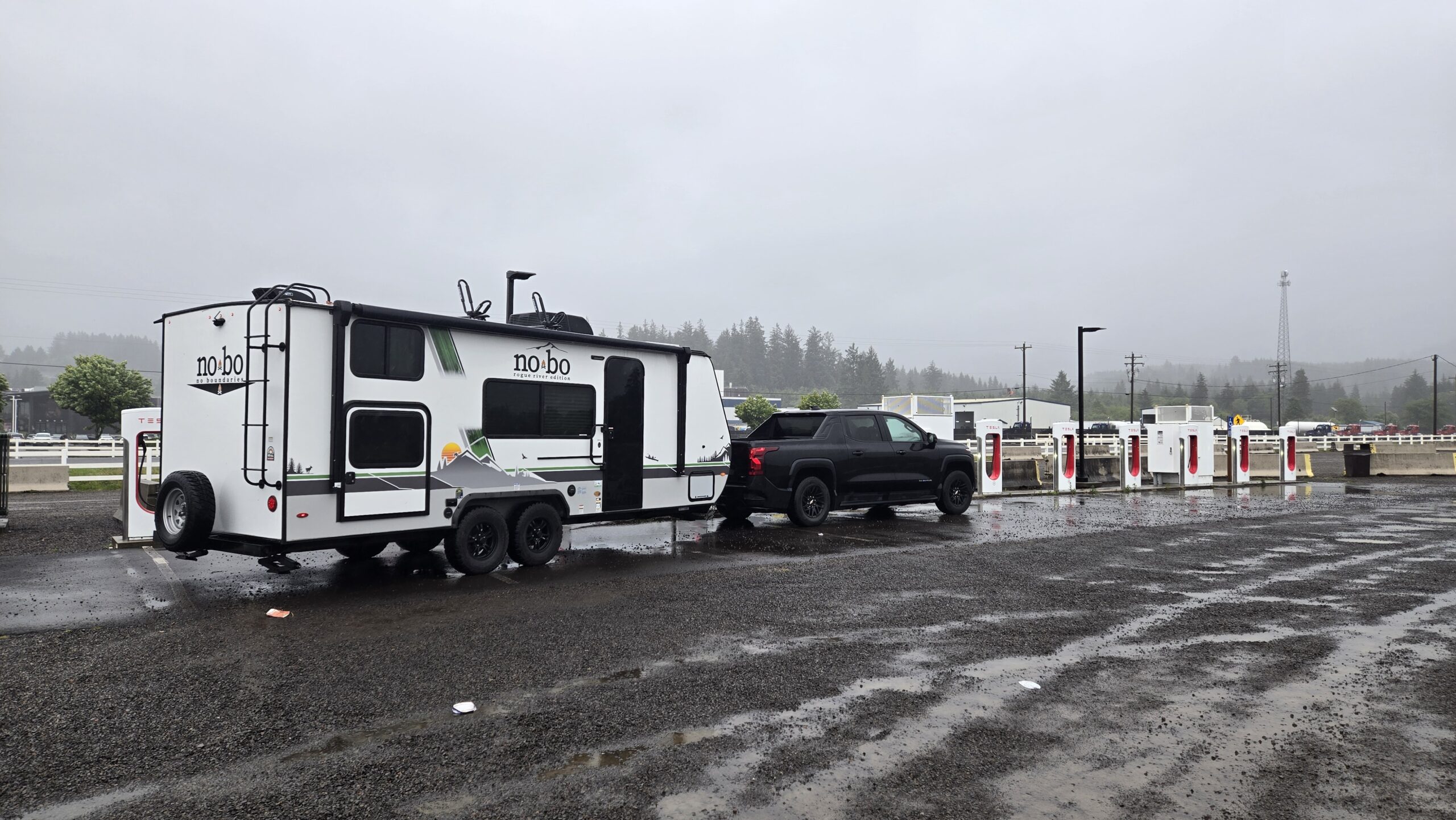
DC Fast Charging (DCFC) has been getting deployed nationwide since the mid 2010s and the networks get better and better every year. The public charging and roadtrips page here provides guidance on doing long drives in an EV, which by now is remarkably easy to do … the second time you do it. The first time? For sure there’s some learning and probably some frustration. Read the page at that link above and get familiar with EV roadtrip basics.
While public DCFC is pretty great these days, one way it is far behind gas stations is lack of “pull through” charging, where you can drive forward into the spot, and then forward again when leaving. Most sites require nose-in / back-in parking, and as of 2026 it’s still rare for a charging stop to offer pull-through spots, although it’s rapidly improving. Until it becomes ubiquitous, here are some tips on finding pull-through charging:
Charging station power matters. The power you get from the charging station becomes more critical when towing, since you’re typically charging a bigger battery (for that EV truck), and probably making more stops due to the trailer reducing your range. A 300 kW station (and an EV that can take it) is literally twice as good as a 150 kW station. Of course, you’ll only be able to take advantage of that higher power if your EV can absorb it; see the towing vehicle selection section above for more on this, including a link to the charging curves.
The independent charge planning apps can help! Plugshare is great for seeing recent reports from EV owners, and photos of the site’s actual layout. It’s useful to get general experience evaluating DCFC sites via Plugshare listings (checkins and photos), learning which brands / hardware are likely to reliably deliver their stated power and which will disappoint. Similarly, ABRP (A Better Route Planner) is an excellent route planner (better than Plugshare’s, for sure), with the ability to take in the efficiency number that you’ve determined above and use that for planning charging stops between point A and point B. You’ll take the miles-per-kWh number that you determined at the beginning of the trip and enter it into the settings. Note that if the route planning app asks for your vehicle’s “watt-hours per mile”, that number is just one math step away (1000 ÷ miles/kWh = Wh/mile); so for example a 1.15 mile/kWh number is precisely the same as 870 Wh/mile.
Finally, for any roadtrip in a CCS-plug vehicle where you want to maximize your public charging options, you should have a DCFC adapter so that you can also use the Tesla/NACS sites that support CCS. See the adapter page here for two recommendations on CCS-car to NACS-station adapters and note that not all Tesla sites have the NACS upgrade required to support CCS, even if you have your own adapter.
EV owners know that by far the easiest way to charge is to just plug in at home overnight. The equivalent to that on a camping roadtrip is to charge at the campground! By filling up overnight at the campground, in theory you are avoiding all the drama and hassle (detailed above) of trying to make use of public charging stops while towing a trailer, but you’re replacing it with the drama of campground electrical service. This section will help you get through that drama.
Campgrounds have surprisingly robust connections to the grid. Pretty much all RV trailers are designed to be plugged in at the campsite, and the big trailers have big 240V inputs, and so most campgrounds equip all of their campsites with electrical service.
In this final section we will walk you through how to charge at the campground, overnight, using an EVSE cordset, and the various pitfalls and solutions around that. Up front, a review of some EV jargon:
Some campgrounds have policies that expressly forbid EV charging! Notably, the large national chain Kampgrounds of America (KoA) is very specific about not allowing EVs to charge on their campsite receptacles, and instead offer real EV charging stations at some of their sites (albeit an extremely limited number.) Wherever you are camping, you could ask ahead of time for permission to charge, but frankly the person you’ll be asking likely won’t know and may respond with the most conservative answer: “no”. As long as you are equipped with the knowledge here and know to dial down your power/current draw, everything should actually work just fine. However, if campground staff calls you out on it, do not argue, and simply accept the fact that you won’t be able to charge there. You can also offer to pay an extra fee for the electricity consumed, say $10-$20 per night, and optionally you can get into the math of the actual cost of the electricity consumed, but that is often not a productive conversation.


Campgrounds typically offer three kinds of electric receptacles at each campsite:
The overall concept is that you’ll plug the trailer into the NEMA TT-30, and your EV into the NEMA 14-50. The TT-30 is of little use for EV charging, because while it’s on a 30 Amp circuit that theoretically offers higher power than the regular NEMA 5-15 wall outlets, EVs won’t go that high on a 120V circuit. If the EV sees 120V coming in, it will top out at 12 Amps, and there’s no override for that (well some Teslas can be pushed to go to 16 Amps). Conversely, the trailer does expect to pull up to 30 Amps, and it’s therefore perfectly aligned with plugging into that TT-30. You’ll definitely want to put your EV on the NEMA 14-50, which has way more power anyway.
The primary challenge is that campgrounds are notorious for poor quality receptacles and circuits. For example, a NEMA 14-50 is supposed to offer 50 Amps peak, and 40 Amps continuous, but rarely does so reliably at campgrounds. If you draw anywhere close to 50 Amps you will trip the breaker, and likely will even if you only pull 40 Amps. The problem is that receptacles can get wired up imperfectly, and they spend their lives exposed to the elements, at the very least suffering temperature and humidity swings even if they are sheltered inside an enclosure against direct precipitation .
The trick then is to reduce your current draw, reduce how much power you are pulling, to below the threshold where the receptacle has a problem and causes the charging to stop, either due to voltage sag (detected by EV or EVSE) or simple breaker trip. EV owner experience at RV campgrounds has shown that if you can dial down your current draw (power) to 35 Amps or lower, the charging is much more likely to keep going through the night. So here are three some solutions to get that slightly reduced power:
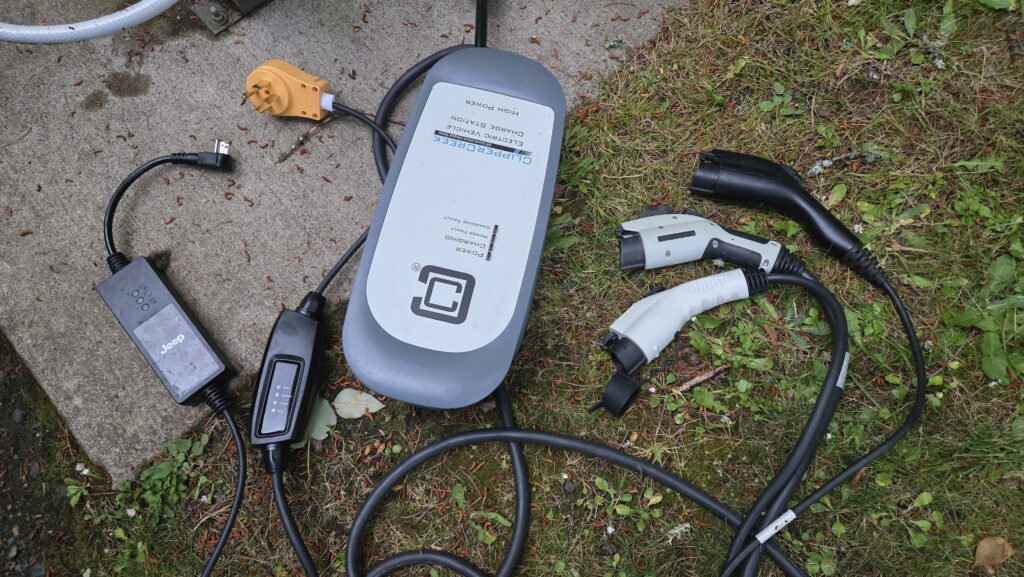
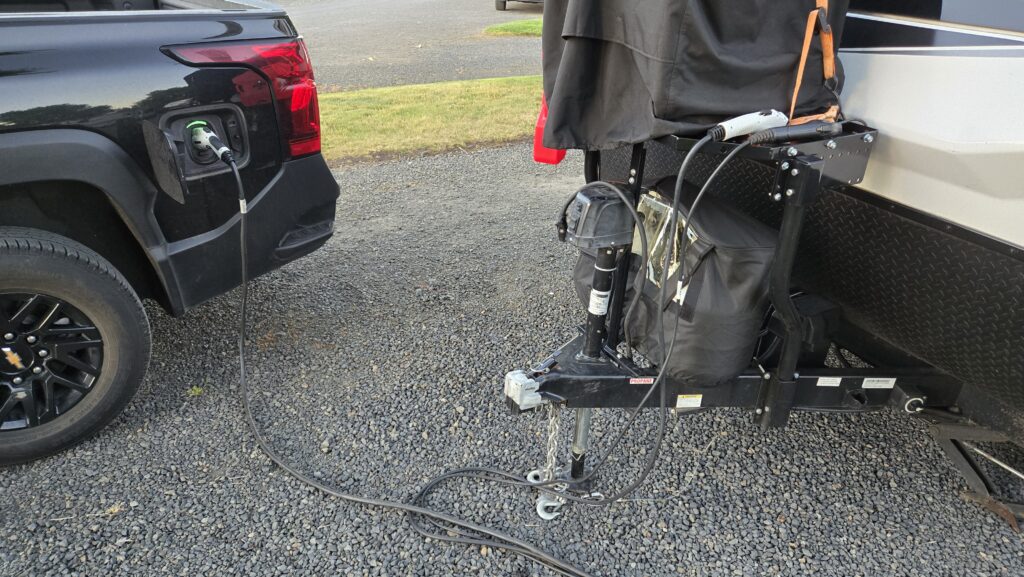
Ideally, you head into the campground armed to the teeth with those three EVSE solutions: a high-power (32 Amp) Level 2 EVSE, a medium-power (16 Amp) Level 2 EVSE (or a high-power EVSE on which you can adjust the power/current down), and a low-power Level 1 EVSE. Between the three of them you should get enough juice overnight so that you can execute your driving segments without ever having to stop at public charging. Note that if you’ve got a truck with a big battery, even charging on full speed Level 2 (6-7 kW) you’re not going to be fully charged in one overnight session. But as long as you’re not towing 100+ miles every day, you’ll get back up to full charge after 2-3 nights.
Even at reduced power, a typical failure is that charging starts fine, but trips in middle of night due to campground wiring or breaker overheating. Before turning in for night, check the vehicle for any charging alarm settings and turn them off, unless you want to be That Guy who wakes up the entire campground at 3am with your car alarm going off.
As noted above, the fundamental challenge of pulling off a towing roadtrip in an EV is the lack of pull-through charging at DCFC site. As the DCFC rollout matures, including popping up at large highway gas stations with their sprawling lots and many travel stop amenities, expect to see pull-through availability become the norm rather than the exception.
This article focuses on towing with and campground charging of a pure electric tow vehicle. There are already lots of PHEV models out there that can simply burn gas as needed. Further, though, there are more EREV / REEV models coming soon, what the NYT calls “super-hybrids” (archive link, no paywall) that neutralize any charging concerns by also burning gas. That flexibility would essentially make this entire article moot, but at the expense of driving on fossil fuels while towing. The whole point of this website is to electrify as much as possible, and get you off fossil fuels, so we focus here on the pure EV case. Note also that we have seen EREV / REEV models come to market in the past (Chevy Volt, BMW i3), these were greeted with indifference and never really caught on, partially because they were confused with the inferior PHEV models. So it remains to be seen what really happens with these new EREV / REEV models.
While this article was written after one particular roadtrip with a larger trailer (25 feet, 5000 pounds) and a big-battery truck (Chevy Silverado EV), it is based on the author’s experience over multiple such roadtrips, including with smaller trailers and more modest EVs. Further, additional guidance was contributed by other EV owners, and some of the experience documented here comes from EV owner forums.
Special thanks go to:
– Merlyn Hough of Eugene Oregon’s Emerald Valley EV Assoc for loaning his Clipper Creek HCS-40
– Alan Shedd and Eric Smith, fellow EV activists in metro Atlanta, for their contributions to this article