
Sections below
 Charging around town
Most EV owners charge at home and rarely need to use public charging. They plug in when they get home, charge overnight, and have a fully charged car every morning – does your gas car do that? For most people, by far, this satisfies their charging needs, and they don’t need public charging that much. But for the occasional long day, and general peace of mind, there are EV charging stations all over town.
If you can’t charge at home, you will need to use public charging. Typically this happens when you live in a multi-unit building where they have not yet installed EV charging for their residents, or you don’t have a driveway or garage.
Fortunately, there are now literally hundreds of EV charging stations across metro Atlanta. Typically they are located at retail complexes that you are going to be at anyway — grocery stores, shopping malls, movie theaters. Mostly these are Level 2 stations that take a few hours to charge your car, but increasingly we are now also seeing DC Fast Charging (DCFC) stations which can charge your car much faster, on the order of minutes rather than hours.
Roadtrips in EVs are now possible! DCFC stations started getting deployed across the country (on interstate routes) in the 2010s, and every year brings more of them. Most EVs sold since 2019 or so can absorb up at least 100 kW of charging power, and most new DCFC stations can deliver at least that much power. This faster charging power means shorter charging stops. You can drive for 2-3 hours, exhausting the range of your car, and then stop for just 25-35 minutes to charge (and grab some food, take a bathroom break, etc.) and hit the road again. Some EVs can absorb 200 kW or higher, and when paired with a similarly capable DCFC station, the charge time can drop to just 10 minutes! This is truly a game changer and eliminates the last annoyance of driving electric.
These charging stations are not free, but the cost is actually pretty much irrelevant.
Essentially, the fact that these stations even exist, regardless of cost, means you can buy an EV and use it as your sole car, even for roadtrips. For that reason many EV owners are happy to pay whatever the charging cost is, even if it’s more than gas, because most of their charging by far is actually done at home for pennies.
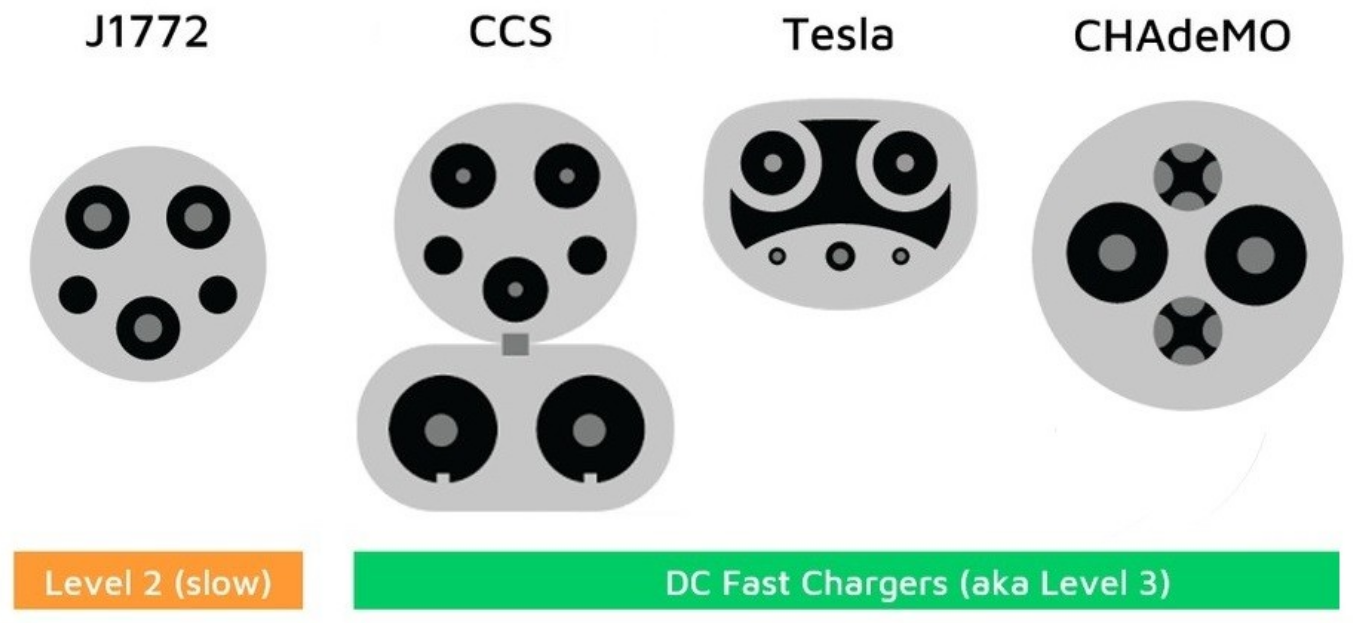
There are three different plug types for DC Fast Charging (DCFC):
While seeing three different plugs to do the same thing may seem bewildering and disappointing at first, the EV market has actually been converging to a single plug for years. The sordid history of all this is described at length on the charging adapters page here, but for purposes of introducing you to roadtripping in an EV, here’s what you need to know:
When looking for a DCFC station for charging your car, you should be aware of these three competing standards. Fortunately, Plugshare makes this easy for you — you just tell the app what kind of car you have, and it will then only show you DCFC stations that are compatible with your car.



Plugshare ( www.plugshare.com ) is a crowd-sourced system, available via web browser and smartphone app, that provides information about all charging stations, not just those for a one particular network (like the Chargepoint or EVgo systems do). The map embedded here at left is a live view into the system that you can move and click around in; click on the Plugshare link above for a larger view.
The Plugshare system provides detailed information on exact location, including photos, provided by the EV ownership community. This exact location information is crucial because these stations usually aren’t huge and obvious like a gas station, and can be hard to find at first, e.g. tucked around the side of a building. Further, Plugshare has a user “checkin” feature where EV owners just like you can report how well the station worked for them — and since Plugshare is independent, the charging company can’t delete the negative checkins. When planning a roadtrip where you will rely on a particular station, it is crucial to “check the checkins” to make sure that others have had success using the station recently.
There’s a quirk in how Plugshare shows Tesla sites, and whether a particular site will work for a non-Tesla, described in the Tesla section farther below.
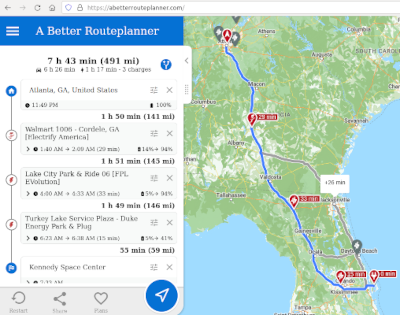
Another great website / app to use for roadtrips is A Better Route Planner (ABRP). You tell ABRP what model car you have (thus the plug type, charging speed, expected range, etc.), and the beginning and end of your planned drive, and it will then calculate exactly which charging sites to stop at along the way and even how many minutes you’ll need to be charging. It is highly configurable to match your preferences, such as how fast you like to drive (i.e. faster means less efficient), whether you want more or less frequent stops, what ending state of charge (SOC, e.g. 10%) you are comfortable with, and so on. It even shows live status of the stations and shows the walking distance to nearby restaurants. It does take some learning to use all the features but is quite valuable as a roadtrip planning tool. Note: ABRP is typically better at this kind of route planning than the navigation built into the car; Plugshare also offers a planning tool but it is far inferior to ABRP.
Each charging provider (Chargepoint, EVgo, Tesla, etc.) has its own app that provides live status of their stations. This live status may also be offered with the two apps above (Plugshare and ABRP), or in your car’s app, or even inside your car’s navigation system, but that live data integration is very unreliable and frankly should be ignored. So if you are really counting on a particular site to work, use that network’s own app to check live status.
Similarly, you can use those charging provider apps to start charging sessions, which then get charged to the credit card that you configure in their app. For many stations, you don’t need to bother with their app, and and instead you just use the credit card directly on the station. Or even better, you use the new “Plug and Charge” technology that allows you to just plug in and your account gets automatically debited. However, these systems can fail (e.g. credit card readers are down) and in that case you’ll want that charging provider app to fall back onto so you can start the charging session.
Tesla has long been the market leader in deploying DC Fast Charging sites around the country (and the world), via what they call their “Supercharger” network. Previously a proprietary network that only Tesla EVs could use, in 2023 they started opening up this vast network to non-Tesla EVs, and by 2026 it was finally available to all EVs. However there a number of caveats to be aware of before relying on Tesla sites for roadtrip charging.
Install the Tesla smartphone app: If you’ve got a non-Tesla EV, and you plan to use the many Tesla supercharger sites, you really should install the Tesla app then a) tell it what model of EV you have, b) tell it whether you have your own adapter, and c) set up your credit card in the app. Most Tesla sites, by far, require that app for payment purposes. But by also telling it what kind of EV you have and whether you have your own adapter, the station map in the app will only show you stations that will work for you, including “Magic Dock” sites.
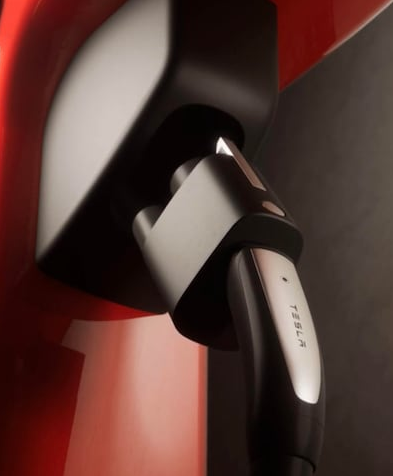
Tesla’s “Magic Dock” sites provide a built-in adapter: If you don’t have your own adapter, it’s important to understand what Tesla’s Magic Dock is and how it works. Some of Tesla’s sites have been equipped with this extra hardware which provides a CCS adapter with each station. You don’t need to bring your own adapter — instead you just walk up, do a special button-press on the plug handle, and -voila- the adapter comes out of the holster with the plug. But you’ll need to use the Tesla app for this to work right, and it will walk you through that process. Like pretty much everything about EVs, it’s weird the first time, and then it’s the new normal.
Only some of the Tesla sites got the NACS upgrade: Tesla started with their own proprietary plug in 2012, but in the early 2020s they worked to standardize it so that other carmakers (and charging stations) could use it, and that standard is now called NACS ( North American Charging Standard ). But while the old proprietary Tesla plug and the new NACS plug look almost exactly the same, they use totally different signaling protocols inside, and a non-Tesla will only work with a NACS plug. A non-Tesla will not work with the old proprietary Tesla plug, which looks exactly the same! Do not assume that your car will work at any Tesla site, even if you have an adapter. Again, do the app setup above and it’ll tell you which sites will work for your situation.
Plugshare’s display is confusing: A quirk about Plugshare is how it displays whether a Tesla site supports non-Tesla EVs. As described above, Tesla has a newer “NACS” plug standard that supports CCS cars but you have to bring your own adapter, and for those sites Plugshare will only show the NACS plug in the listing, but they put a badge on the listing saying “open to non-Tesla”. Further, though, in rare cases, a Tesla site will have stations with the “Magic Dock” built-in adapters described above, and for those sites Plugshare will have that same badge on the listing but will also show the CCS plug in the listing. The key differences here are that some Tesla sites require you to bring your own adapter, some sites will provide the adapter, and finally some sites don’t support non-Tesla EVs at all, even if you brought your own adapter.
800 Volt EVs typically charge slower at Tesla sites: EVs generally come with either 400V drivetrains or 800V drivetrains; 800V technology is explained at greater length here. Either kind of EV can charge at either kind of charging station, but there’s one case where you’ll get much slower charging than you might have gotten used to. Tesla has almost exclusively used 400V platforms in their EVs, and they built their supercharging network at 400V to match that. If you have an 800V car (e.g. any of the Korean models from Hyundai, Kia or Genesis), your car has to do an internal voltage conversion, and that internal converter limits how much power your car can pull from the station. The actual bottleneck number depends on the model, but it’s about 100 kW in the Hyundai example here, which is far less than you’d normally expect for your 800V EV, and definitely less than Tesla claims the site delivers (250 kW or 325 kW or whatever). Therefore a non-Tesla charging site may be a more attractive roadtrip stop, if you want to charge faster and get back on the road quicker. Note: Tesla is slowly rolling out 800V stations (with new “V4 cabinets”) that do support 800V properly, but as of 2026 they are still quite rare.
As mentioned above, the oldest Tesla supercharging sites did not get the NACS upgrade, and so do not support non-Tesla EVs. You can’t tell which of the three kinds a Tesla site is just by looking at it from afar. Just because you’ve charged at a Tesla site before doesn’t mean that you can charge at any Tesla site, even if you have an adapter! Get the Tesla app, configure it with what model EV you have and whether you have your own adapter, and then rely on the map in that app to show you only the sites that will actually work for you. Or, rely on Plugshare, but since they don’t offer that kind of filtering, you need to understand the quirky language they use to see how well a Tesla site supports CCS cars, if it supports them at all.
Etiquette: When charging at a public station, you should be aware of proper charging etiquette.
Avoid car dealerships: Many auto dealers offer charging stations, however those locations will often have limited hours, and each dealer franchise will have its own policy on whether they allow the general public to charge. Check the Plugshare listings for user “checkins” on a particular dealership before counting on it. Frankly, there’s usually too much drama with using a dealer station, so we recommend that you stick to truly public sites.
Free stations are a hassle: If you hunt around in Plugshare you can usually find some stations that don’t cost any money, however you will often find those stations being hogged by people trying to get a few pennies of electricity for free. Consider that using only those stations is perhaps really only free if your time is worthless.
Check out ChargeWay: People new to EVs tend to get pretty confused and frustrated about the different plug types and power levels offered by these stations. ChargeWay is a marketing company in Oregon that came up with a way to simplify the world of EV charging, using a color code and a number. Check out the Green Car Reports article on the ChargeWay concept, which we hope does catch on nationwide.
What’s wrong with using your smartphone to navigate (e.g. via “screen projection” like Apple CarPlay or Android Auto), instead of in-car navigation?
What’s good and bad about using the in-car navigation?
Tesla’s owner experience is a notable exception to the above route planning concerns, and also an exception to most of the extra steps that you need to take below to make sure that the charging stops will work well for you. This is because Tesla offers a vertically-integrated proprietary system where their cars’ navigation system frankly works perfectly with their own stations and their own phone app. If roadtrip route planning was the only thing you cared about then choosing a Tesla would be obvious, but there are literally a hundred other things that should also factor into your car choice. Tesla is not great at everything …
As you can see from the above, the technology and infrastructure has now advanced to the point where EV roadtrips are totally possible and even common. You do need to plan ahead a little bit, so here is a summary checklist of what you should do ahead of and during your roadtrip:
At end of a day-long roadtrip, it’s perfectly fine to arrive nearly empty! But plug in your car (even on super-slow Level 1) before retiring for the night, so that it charges overnight. It is very bad for the long term health of the battery to leave it sitting empty and unplugged overnight — leaving it at below 5% is especially bad. Plug it in!
Finally, after your roadtrip is over and you are back home, remember to set your max SOC back down from 100% to 80%. Some cars will do this automatically, recognizing from GPS that it’s back home, but double check it.
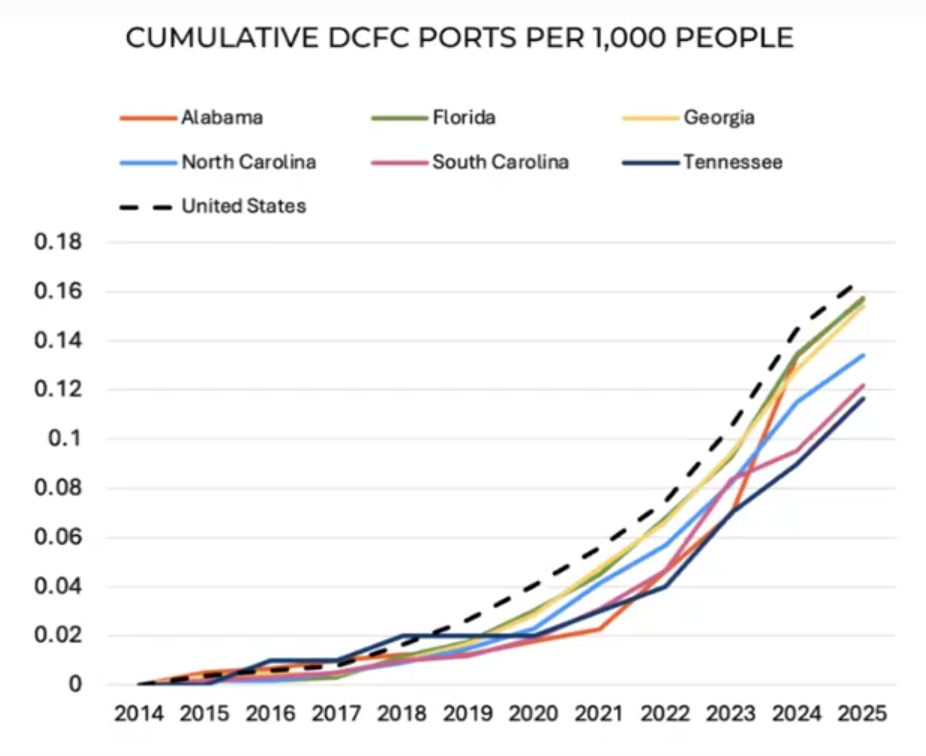
See also the DCFC technology page.
2011: Nissan starts deploying their Chademo-only stations to their dealers.
2012: Tesla starts deploying their Supercharging network, alongside their new Model S luxury sedan. At launch there were only six sites in California, and they only delivered 90 kW, but Tesla soon began expanding nationwide and rapidly improving their technology.
2014: Tesla’s nationwide deployment of their Tesla-only stations reaches Georgia and the US Southeast, providing sparse coverage of our interstates. In the years that followed, they continued to spend vast sums of money to build out truly fantastic charging infrastructure … but for Teslas only.
2015-2017: Georgia Power deploys their first phase of DCFC around the state, offering both Chademo and CCS plugs
2015-2017: EVgo (formerly NRG EVgo) deploys their first phase of DCFC around metro Atlanta. Initially these were Chademo-only stations with Nissan as a funding partner, but later they were upgraded to also offer CCS plugs with funding from BMW.
2018-2019: Electrify America, the massive rollout funded by Volkswagen as part of the Dieselgate settlement package, rolls out the first phase of their charging network. EA stations feature a minimum power of 150 kW, and up to 350 kW, and offer a minimum of four stations at each site. Contrast this with the prior waves of DCFC, such as the Nissan, Georgia Power and EVgo deployments above, which offered 50 kW and typically had only a solitary station at each location. The EA rollout that started in 2018 was the true game changer that finally made EV roadtrips possible. (Note: Tesla owners had already had this capability starting in 2014.)
2019: Georgia Power starts deploying their second phase of DCFC around the state, with each new site typically consisting of two of Chargepoint’s newer CPE250 stations, each offering 62.5 kW. The two stations can pair together to offer 80-125 kW if only one car is present.
2021: EVgo starts a second phase of deployments in metro Atlanta, with DCFC sites consisting of 3-4 stations, each offering between 100 and 350 kW of power.
2022: The Biden administration’s Infrastructure Investment and Jobs Act (IIJA) passes into law in August, and includes funding for a new National Electric Vehicle Infrastructure (NEVI) effort. NEVI will fund the deployment of high-power DCFC across the country, at the same minimally robust level as Electrify America sites described above (4 x 150 kW stations, at least). All of Georgia’s interstates will get upgraded to meet NEVI standards, and two new non-interstate corridors will also get built out with DCFC: US route 82 from Albany to Brunswick, and US Route 441 from Clayton to Dublin. See the Georgia DOT’s website specifically about their NEVI spending plan.
2022: Tesla starts selling an adapter that allows Tesla car owners to charge at CCS sites.
Early 2023: Tesla starts equipping their supercharging DCFC sites with CCS plugs via their new “Magic Dock” technology, which allows non-Tesla cars to charge there. Initially this rollout starts in California and New York state, but will eventually roll out to the entire country, with Tesla saying they would have 3500 CCS-capable supercharger stations completed by end of 2024.
Mid 2023: For many years, Tesla had claimed that their plug standard was available for other manufacturers to use in their cars (and stations), but nobody had taken them up on it (likely for legal/IP reasons) and the entire non-Tesla market had been slowly converging on CCS for a decade. Starting in May 2023, however, suddenly all of the major manufacturers, starting with Ford, announced their abandonment of CCS for Tesla’s plug, which Tesla has dubbed the North America Charging Standard (NACS). Actual standards activity began immediately, including via the SAE who assigned it the number J3400. Expect this process, including supply chains of receptacle and station hardware, to take multiple years to settle out.
Early 2024: Gas station companies finally wake up to the business opportunity and start installing DC Fast Charging station. Pilot / Flying-J partnered with GM, Bucee’s partnered with Mercedes-Benz, and other companies like Circle K and RaceTrac deployed their own solutions. These sites finally brought parity to EV charging, with the best ones offering all of the same amenities as gas cars get: canopies, pull-through stalls, windshield cleaning gear, garbage cans and, most important, proximity to typical travel stop conveniences like restaurants.
Late 2024: After two years of diligent work on requirements and execution, the first NEVI-funded sites started coming online. See this Nov 2024 update from Plug In America on the NEVI rollout status, and check out this map of NEVI sites around the country.
2025: the new presidential administration moves to halt NEVI funding, but eventually lawsuits and other realities kick in and the funds resume flowing. Indeed, 2025 was a banner year for DCFC deployment, as not only did NEVI start to kick in but various commercial efforts hit their strides (GM/Pilot, IONNA, Mercedes-Benz, etc.).
Outreach note: this page is designed such that the most important information fits on the first two pages when printed out, so that you can print those two pages double-sided on a single piece of paper, and then hand out copies of that at outreach events. You don’t need to print out the entire thing, just the first two pages, up to the “checklist” section. You might need to shrink the pages a little bit (in the print dialog) to get it to fit.